
P.T. Barnum’s Greatest Marketing Lesson: You Have to Get Their Attention First
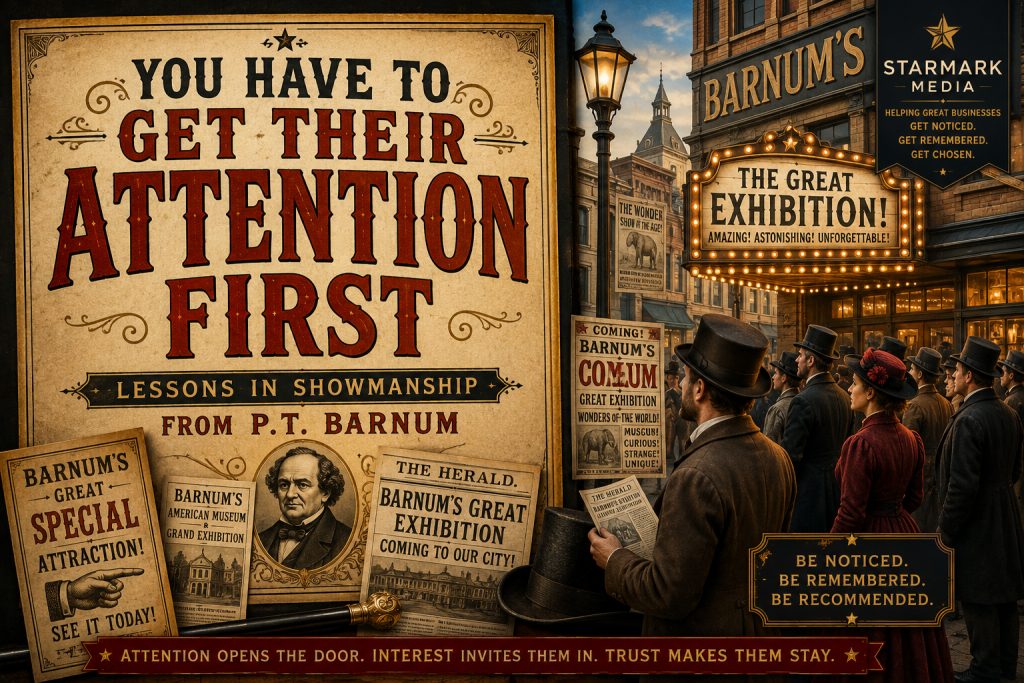
You can have the best product in town.
You can provide better service than your competitors.
You can answer the phone faster, show up when promised, charge a fair price, stand behind your work, and genuinely care about your customers.
But there is one rather inconvenient problem.
None of it matters to the customer who has never heard of you.
Before someone can trust your business, consider your business, call your business, or recommend your business, something has to happen first.
They have to notice you.
Few people in American business history understood that better than P.T. Barnum.
Barnum certainly had his faults. Some of his promotional practices were deceptive and would be unacceptable standards for a modern business. But separating those practices from the legitimate principles of promotion reveals something important: Barnum possessed an extraordinary understanding of how attention worked.
The Smithsonian’s National Museum of American History describes him as a master of promotion and records one of his observations about advertising:
“Advertising is to a genuine article what manure is to land—it largely increases the product.”
Notice two important words in that statement:
Genuine article.
Barnum understood that having something worth selling and making people aware of it were two separate jobs.
More than 150 years later, that may be one of the most important lessons a local business owner can learn.
The First Sale Isn’t Your Product. It’s Attention.
Think about what happens every day on Facebook.
A homeowner opens the app.
Within a few minutes, they may see family photos, breaking news, a funny video, a political argument, a recipe, a friend’s vacation pictures, an advertisement, a neighborhood complaint, a cute dog, a sports highlight, and dozens of other posts.
Somewhere in the middle of all of that appears:
“ABC Plumbing provides residential and commercial plumbing services. Call today for a free estimate.”
Scroll.
The plumbing company might be excellent.
But it never had an opportunity to demonstrate that excellence because it lost the first battle.
It didn’t earn attention.
This is where many businesses misunderstand marketing.
They immediately begin trying to sell.
Call us.
Book now.
Free estimates.
10% off.
Schedule today.
Those messages have their place.
But they’re asking someone to make a buying decision before giving that person much reason to stop and pay attention.
Barnum approached the problem differently.
First, get them to look.
Then give them something worth looking at.
Barnum Didn’t Wait for People to Discover Him
Barnum operated during an era when advertising looked very different from today. Newspapers, handbills, trade cards, signs, posters, and eventually enormous colorful lithographs were among the tools available to promoters.
And Barnum used publicity aggressively.
When his traveling show arrived in a region, promotion didn’t begin when the tent went up.
It began beforehand.
PBS’s American Experience describes promotional campaigns involving posters, newspaper publicity and even a self-published newspaper distributed in enormous quantities. Barnum’s circus advertised far beyond the immediate town where it would perform, helping attract audiences from surprisingly long distances.
The Smithsonian’s Barnum collection similarly describes him as a great believer in advertising who made it his business to be talked about.
That last idea deserves some attention.
He made it his business to be talked about.
How many local businesses make that part of their business?
Most don’t.
They do the work.
They send the invoice.
They move on to the next job.
But something interesting may have happened during that job that could have become tomorrow’s marketing.
Your Everyday Work May Be More Interesting Than You Think
Imagine a pressure washing company arrives at a home where the driveway hasn’t been cleaned in eight years.
Halfway through the job, there is an incredible dividing line:
One side is stained and dark.
The other looks almost new.
That’s interesting.
Take the picture.
Imagine an electrician discovers an outdated panel that has been causing a homeowner’s mysterious electrical problems.
That’s interesting.
Explain it.
Imagine a roofer discovers the source of a leak isn’t where the homeowner assumed it was.
That’s interesting.
Tell the story.
Imagine a mobile detailer works on a vehicle that hasn’t had a proper interior cleaning since the owner’s children were toddlers.
That’s interesting.
Show the transformation.
Imagine a septic technician gets asked the same unusual question three times in one week.
That’s interesting.
Answer it publicly.
This is where showmanship becomes extremely practical.
You don’t necessarily need to invent something interesting.
You need to become better at recognizing what is already interesting about your business.
Barnum’s Jenny Lind Campaign Offers a Fascinating Example
One of Barnum’s most interesting promotional achievements didn’t involve a circus at all.
It involved an opera singer.
In 1850, Barnum brought Swedish singer Jenny Lind to America.
There was a problem.
Lind was celebrated in Europe, but she was not yet a household name among the American public.
Barnum couldn’t simply rely on people already knowing who she was.
So he built anticipation around her arrival.
The Smithsonian describes Barnum’s pre-arrival promotional effort as an unusually extensive campaign that helped transform Lind from a comparatively little-known European performer in America into a household name. Scholars have subsequently examined the campaign as an early example of deliberate celebrity branding.
Think about what that means from a marketing standpoint.
Barnum was marketing the experience before much of his audience had experienced the product.
He created recognition.
Recognition created curiosity.
Curiosity created anticipation.
Anticipation created demand.
That progression still works.
Attention → Curiosity → Familiarity → Trust → Action
Too many businesses try to jump directly from invisible to action.
Never heard of us? Call today!
Marketing usually doesn’t work that neatly.
You Don’t Need Barnum’s Ethics to Learn From Barnum’s Marketing
This is an important point in any serious discussion of P.T. Barnum.
Barnum’s history contains exploitation, deception, fabricated stories, and promotional practices that should not be romanticized. Smithsonian historians note that some of his attractions and publicity relied on deliberate humbug and falsehoods.
Modern businesses should draw the line very differently.
Attention without honesty destroys trust.
A local business depends heavily on reputation.
One misleading advertisement can become a screenshot.
One exaggerated claim can become a negative review.
One bait-and-switch promotion can undo years of goodwill.
So the modern Barnum lesson isn’t:
Do anything necessary to get attention.
It’s:
Find honest ways to make the truth more interesting.
That’s a very different philosophy.
And it’s much more sustainable.
Don’t Manufacture a Spectacle. Find Your Spectacle.
Suppose you’re a tree service.
You don’t need to stage something outrageous.
You already have 60-foot trees, enormous equipment, skilled climbers, storm damage, precision cuts, cranes, ropes, chainsaws, and dramatic transformations.
That’s visual.
Suppose you’re a landscaper.
You already have transformations.
Suppose you’re an electrician.
You have demonstrations and explanations.
Suppose you’re a plumber.
You have mysteries to solve.
Suppose you’re in pest control.
You have things homeowners desperately want to know are not living inside their walls.
Every industry contains its own version of showmanship.
The challenge is finding it.
Ask yourself:
What would make someone stop scrolling?
What would surprise a homeowner?
What question do customers constantly ask us?
What do we know that most customers don’t?
What transformation can we show?
What misconception can we correct?
What happened today that made our employees laugh?
What customer story made us feel good about what we do?
Those questions uncover marketing material.
Attention Doesn’t Always Mean Being Loud
There is another misconception worth addressing.
Getting attention does not necessarily mean:
BIG RED LETTERS!!!
Or flashing graphics.
Or outrageous claims.
Or trying to be funny every day.
Sometimes the strongest attention comes from relevance.
A homeowner scrolling past a post titled:
“Three Signs Your Electrical Panel May Be Outdated”
may stop because their home was built in 1974.
Someone sees:
“Why Does One Side of My House Keep Turning Green?”
They stop because they’ve wondered exactly that.
A pool owner sees:
“Your Pool Can Look Clear and Still Have a Water Chemistry Problem.”
Now they’re curious.
A homeowner sees:
“That Small Roof Stain May Be Telling You Something.”
They look at the ceiling.
Attention doesn’t require shouting.
Sometimes attention comes from saying the right thing at exactly the right moment.
The Headline Has One Job
This brings us to one of the simplest lessons in marketing:
The headline does not need to sell the entire product.
It needs to get someone to read the next line.
Your social media graphic doesn’t need to explain your entire company.
It needs to stop the scroll.
Your email subject line doesn’t need to close the sale.
It needs to earn the open.
Your website headline doesn’t need to tell the visitor everything.
It needs to make them interested enough to continue.
This is where businesses frequently overload their marketing.
They try to put everything on one graphic:
Company name.
Phone number.
Website.
Five services.
Free estimates.
Financing available.
Twenty years of experience.
Licensed and insured.
Three pictures.
A coupon.
And a call to action.
Technically, everything is there.
But nothing gets attention because everything is competing for attention.
Barnum understood spectacle.
Modern marketing needs to understand focus.
Give the eye somewhere to go.
Give the mind one idea to understand.
Then lead the customer to the next step.
Familiarity Is Built One Impression at a Time
Not every piece of marketing needs to produce an immediate sale.
That may sound strange coming from a marketing company.
But consider how people actually hire local service businesses.
Someone sees your landscaping post today.
They don’t need a landscaper.
They see another post Thursday.
Still don’t need one.
Next week they see a funny post from your company.
A month later they notice a before-and-after project.
Then they see someone in a neighborhood Facebook group mention your company.
Three months later, they’re finally ready to redo their yard.
Now something has changed.
They know your name.
Your competitor may be seeing that customer for the first time.
You’ve already been introduced five times.
That is the cumulative power of attention.
A single impression can introduce you.
Repeated impressions can make you familiar.
And familiarity can make choosing you feel less risky.
Barnum Thought Bigger Than the Advertisement
One reason Barnum remains such an interesting figure in marketing history is that he didn’t limit promotion to conventional advertisements.
The promotion itself could become entertainment.
Circus promoters used advance teams, colorful posters and spectacular parades to attract audiences before the actual performance.
The distinction between the show and the advertising for the show became blurry.
That’s an intriguing idea for today’s businesses.
What if your marketing were useful enough, interesting enough, funny enough, or entertaining enough that people didn’t mind seeing it?
That’s very different from an advertisement someone tolerates.
Imagine a pest control company’s Facebook followers actually looking forward to its humorous posts.
Imagine a roofer becoming known for simple one-minute videos explaining things homeowners don’t understand.
Imagine a septic company becoming the source of surprisingly fascinating “Did You Know?” posts.
Imagine an electrician creating a weekly series called “Would This Pass Inspection?”
Imagine a landscaper regularly showing “What We Found Underneath This Yard.”
Now the marketing itself has value.
People don’t merely see the business.
They begin following it.
That’s a much more powerful position.
The Goal Isn’t Attention for Attention’s Sake
There is one final distinction that matters.
Attention by itself isn’t the goal.
You can stand on the sidewalk dressed like a chicken and get attention.
That doesn’t necessarily build your business.
The right attention needs to lead somewhere.
For a local business, the progression might look something like this:
ATTENTION
That caught my eye.
↓
INTEREST
That’s actually interesting.
↓
RECOGNITION
I’ve seen this company before.
↓
TRUST
They seem to know what they’re doing.
↓
MEMORY
I’ll remember them.
↓
ACTION
That’s who I’m going to call.
That is the kind of attention worth building.
What Would Barnum Put on the Poster?
Here’s a simple exercise you can try with your own business.
Forget your current advertisements for a moment.
Forget your service list.
Forget the phrase “Call Today.”
Instead, imagine P.T. Barnum walked into your business and spent an entire day watching what you do.
At the end of the day, he has to create one enormous poster that will make the whole town curious about your company.
What would he put on it?
Would he feature an incredible transformation?
A fascinating piece of equipment?
An employee with an unusual skill?
A customer success story?
Something homeowners commonly misunderstand?
A surprising fact?
A dramatic before-and-after?
A guarantee?
A tradition?
Your history?
Your personality?
Your community involvement?
Whatever your answer is, there’s a good chance you’ve just discovered something that deserves a larger role in your marketing.
Being Great Is the Beginning. Being Noticed Is the Next Step.
P.T. Barnum lived in a world without Facebook, Instagram, Google, YouTube, smartphones, websites, or digital advertising.
But the fundamental challenge hasn’t changed.
Businesses are competing for attention.
Today, they’re simply competing for it in a much more crowded arena.
Your business doesn’t need to become louder than everyone else.
It doesn’t need gimmicks.
And it certainly doesn’t need deception.
It needs to become interesting enough to notice, useful enough to follow, consistent enough to remember, and trustworthy enough to choose.
Because before customers can discover how good you are, they first have to discover you.
That’s the Barnum lesson.
And more than a century later, it’s still good marketing.
Is Your Business Getting the Attention It Deserves?
You already have a business to run.
Finding something worthwhile to say every day—and consistently turning it into professional marketing—is another job entirely.
The Starmark Growth System™ helps local businesses stay visible with consistent social media content, professional branding, customer review marketing, and a steady presence designed to keep your business in front of the people you want to reach.
You concentrate on putting on a great show.
We’ll help make sure there’s an audience.
Leave a Reply
You must be logged in to post a comment.