
Walt Disney Didn’t Build Rides—He Built Experiences
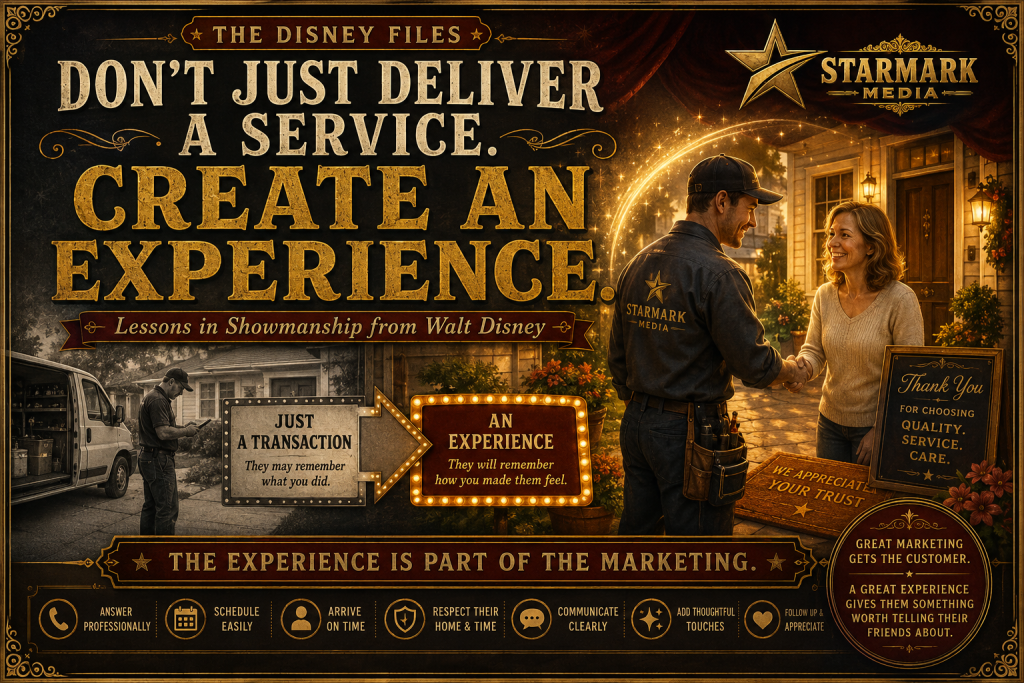
Ask someone who has visited Walt Disney World what they remember, and chances are they won’t begin by describing the mechanical specifications of a ride.
They’ll tell you about walking down Main Street and seeing Cinderella Castle for the first time.
They’ll remember their child’s reaction to meeting a favorite character.
They’ll remember the music.
The fireworks.
The smells.
The anticipation.
Maybe they’ll remember a Cast Member who did something unexpectedly kind.
They may even remember something as simple as eating a Mickey-shaped ice cream bar while sitting on a curb waiting for a parade.
Individually, none of those things explains Disney’s success.
Together, they reveal something Walt Disney understood extraordinarily well:
People don’t simply remember what you sold them.
They remember how you made them feel while experiencing it.
And that lesson has almost nothing to do with amusement parks.
It applies to plumbers.
Electricians.
Roofers.
Landscapers.
Pressure washing companies.
Property managers.
Mobile detailers.
Septic companies.
And virtually every other local business.
Because whether you realize it or not, every time someone hires your company, you’re creating an experience.
The question is whether you’ve designed that experience—or simply allowed it to happen.
Walt Disney Wasn’t Satisfied With Building Another Amusement Park
When Disneyland opened in Anaheim, California, in 1955, amusement parks were certainly nothing new.
Disney’s innovation wasn’t inventing the amusement ride.
It was creating an environment where rides were only part of a much larger story.
The Walt Disney Family Museum describes Disneyland as a place Walt envisioned as unlike traditional amusement parks—a carefully conceived environment where guests could enter different lands and become immersed in the stories surrounding them.
That distinction matters.
Disney wasn’t merely asking:
“How can we build a better ride?”
He was thinking about a much bigger question:
“What should people experience?”
That changes everything.
If you’re only selling a ride, your competition is another ride.
If you’re selling an experience, suddenly everything matters.
The entrance matters.
The landscaping matters.
The costumes matter.
The music matters.
The cleanliness matters.
The signage matters.
The employee interaction matters.
The story matters.
Even the way someone leaves matters.
Disney understood that the product wasn’t simply sitting at the end of the customer journey.
The entire journey was the product.
That’s a powerful lesson for any business.
Your Customer Is Having an Experience Whether You Designed One or Not
Imagine you need an electrician.
You search online and find two companies.
You call the first one.
The phone rings seven times.
Someone answers:
“Hello?”
You ask whether you’ve reached the electrical company.
“Yeah.”
You explain the problem.
The person sounds distracted and eventually tells you someone might be able to come out Thursday.
You ask what time.
“Probably sometime in the afternoon.”
Now call the second company.
“Good morning, Johnson Electric. This is Sarah. How can I help you?”
You explain the problem.
Sarah asks a couple of questions.
She tells you:
“We can have Mike there Thursday between 1:00 and 3:00. We’ll send you a confirmation, and you’ll receive a message when he’s on the way.”
Same basic service.
Two completely different experiences.
The electrician hasn’t even arrived yet.
And the customer has already started forming an opinion.
That’s the Disney lesson.
The experience begins long before the primary service is delivered.
Marketing Doesn’t End When the Customer Calls
Businesses often divide marketing and operations into two separate worlds.
Marketing gets the customer.
Operations performs the service.
But customers don’t experience your company in departments.
They experience one business.
They don’t know that your website was created by one person, your Facebook page is handled by another, the receptionist works in the office, and the technician is in the field.
To them, it’s all the same company.
That means every interaction either reinforces or contradicts your marketing.
Your advertisement says:
“Professional service you can trust.”
Then someone doesn’t return the customer’s phone call.
Contradiction.
Your website says:
“We respect your home.”
Then a technician walks across the carpet with muddy shoes.
Contradiction.
Your Facebook page says:
“We treat every customer like family.”
Then nobody responds to a complaint.
Contradiction.
On the other hand, imagine your marketing promises professionalism—and then every interaction confirms it.
The phone is answered professionally.
Appointments are confirmed.
The technician arrives in a clean vehicle.
The customer receives an introduction.
The work is explained.
The property is respected.
The invoice is clear.
Someone follows up afterward.
Now the marketing promise becomes believable.
Because the customer experienced it.
Disney Understood That Details Tell the Story
One of the most fascinating things about Disney’s approach is the attention paid to details many guests may never consciously analyze.
The architecture changes from one themed area to another.
Music supports the environment.
Landscaping helps create transitions.
Employees are called Cast Members.
Work areas inaccessible to guests are considered backstage.
Even the language reinforces the idea that the guest has entered a carefully constructed experience.
Most customers will never walk out of a Disney park saying:
“The transition in landscaping between those two areas was exceptionally effective.”
But they may say:
“Everything just felt different.”
That’s the power of details.
Customers often notice details without consciously identifying them.
The same thing happens with your business.
A customer may never say:
“I appreciated the typographic consistency between your website and your service vehicle.”
They simply think:
“This company looks professional.”
They may never say:
“The communication cadence between appointment confirmation and technician arrival reduced my uncertainty.”
They say:
“They kept me informed.”
They may never say:
“The employee’s attention to protecting my flooring positively affected my perception of the brand.”
They say:
“They really respected my house.”
Customers translate hundreds of tiny details into simple conclusions.
Professional.
Unprofessional.
Trustworthy.
Disorganized.
Friendly.
Expensive.
Worth it.
I’d use them again.
I wouldn’t use them again.
The details create the conclusion.
What Are Your Customers Seeing?
Here’s a useful exercise.
Pretend you’ve never heard of your business.
Now become the customer.
Search for your company on Google.
What do you see?
Look at your Google Business Profile.
Are the photos current?
Are there recent reviews?
Are questions answered?
Now visit your website.
Does it load quickly?
Can you immediately tell what the company does?
Does it look good on a phone?
Does it feel current?
Can you easily figure out how to contact someone?
Now visit Facebook.
When was the last post?
Yesterday?
Last week?
Eight months ago?
Does the page look active?
Does the cover image accurately represent the business?
Do the posts show expertise, personality, customers, employees, and actual work?
Or does the page feel abandoned?
Now call the business.
How many rings?
How are you greeted?
What happens if nobody answers?
What does the voicemail sound like?
What happens after you request an appointment?
What happens when the employee arrives?
What happens when the job is finished?
That’s your customer experience.
Not just the work you perform.
Everything surrounding it.
The Parking Lot Is Part of the Product
This is one of my favorite ways to explain the Disney philosophy.
Imagine spending millions of dollars creating an incredible attraction but ignoring everything surrounding it.
The parking lot is confusing.
The bathrooms are dirty.
Employees don’t know where anything is.
Signs contradict each other.
Nobody answers questions.
Trash is overflowing.
The attraction itself might still be fantastic.
But what does the customer remember?
The entire day.
Local businesses sometimes make the same mistake.
They obsess over the technical quality of the primary service while ignoring everything around it.
A roofer may install an excellent roof but leave nails in the driveway.
A mobile detailer may make the car beautiful but arrive an hour late without calling.
A landscaper may create an incredible yard but take four days to return messages.
A plumber may fix the problem perfectly but leave the work area dirty.
An electrician may perform flawless work but never explain what was done.
In each case, the technical work may deserve five stars.
But customers don’t review technical work in isolation.
They review the experience.
The Customer Doesn’t Know What You Know
This is particularly important for skilled trades.
The customer usually cannot evaluate your technical expertise the same way another professional can.
A homeowner probably can’t inspect an electrical panel and determine whether every connection was handled beautifully.
They may not know whether a roof flashing detail was executed perfectly.
They may not understand water chemistry.
They may not know the proper pressure for cleaning a particular exterior surface.
They may not know exactly how a septic system works.
So how do they decide whether you’re good?
They look for signals.
Did you arrive when promised?
Did you seem knowledgeable?
Did you answer their questions?
Did you explain the work clearly?
Did you protect their property?
Did you look professional?
Did you clean up afterward?
Did the final bill match expectations?
Did you make them feel comfortable?
Those things become proxies for quality.
That’s why customer experience isn’t merely a “nice extra.”
It helps customers understand the quality they may not otherwise be qualified to judge.
Give Customers a Story They Can Repeat
This is where customer experience becomes marketing.
Imagine two homeowners talking over the fence.
One says:
“We had our air conditioner repaired yesterday.”
The neighbor asks:
“Who did you use?”
The homeowner replies:
“ABC Heating.”
“How were they?”
“They were fine.”
That’s technically a positive review.
But there’s not much energy behind it.
Now imagine:
“We used ABC Heating. You’ll love this—they texted me a picture of the technician before he arrived so I knew exactly who was coming to the house. He put covers over his shoes before walking inside, explained exactly what had failed, and even showed me the old part before replacing it.”
That’s a story.
And stories travel.
The remarkable part doesn’t have to cost much.
Sometimes it’s a handwritten thank-you.
A follow-up message.
A photograph.
A small gift.
An unexpectedly clean work area.
Remembering the customer’s dog.
Explaining something nobody else bothered to explain.
Helping with something technically outside the scope of the job.
The question is:
What happens during your customer experience that someone would actually tell another person about?
That’s where referrals begin.
A “Wow” Moment Doesn’t Have to Be Expensive
When business owners hear “Disney-level customer experience,” they sometimes imagine elaborate gestures.
That’s unnecessary.
Small moments can have enormous impact precisely because customers weren’t expecting them.
Suppose a pressure washing company finishes cleaning a patio.
Before leaving, the technician carefully puts the patio furniture back exactly where it was.
Small thing.
Suppose a mobile detailer leaves a small microfiber cloth in the cupholder with a note:
“For fingerprints between visits.”
Small thing.
Suppose a plumber notices the homeowner has a curious child watching and takes thirty seconds to explain what the tool does.
Small thing.
Suppose a landscaper texts the homeowner three photos after finishing because the customer is at work and hasn’t seen the transformation yet.
Small thing.
Suppose a roofer sends a photograph showing exactly what was repaired in a place the homeowner cannot safely see.
Small thing.
But small things become memorable when nobody else does them.
That’s showmanship without spectacle.
Your Employees Are Part of Your Marketing
Disney famously refers to employees in its parks as Cast Members.
There’s a valuable concept hidden in that terminology.
Every employee who interacts with a customer is representing the brand.
For local service companies, the technician may actually have more influence over the brand than the owner.
The customer may never meet the owner.
But they meet the technician.
That technician’s appearance matters.
Their language matters.
Their attitude matters.
Their vehicle matters.
How they answer questions matters.
How they react when something goes wrong matters.
How they leave the property matters.
You can spend thousands of dollars building a beautiful brand.
But if the person who arrives at the customer’s house acts like they don’t want to be there, that becomes the brand.
Conversely, an exceptional employee can create customers for life.
That’s why customer service training isn’t merely an operational expense.
It’s marketing.
The End of the Experience Matters Too
Businesses put enormous effort into getting customers through the front door.
Very few put equal thought into the exit.
But the end of the customer experience is particularly important because it’s close to the moment when the customer forms their final impression.
The job is complete.
What happens now?
Do you simply collect payment and leave?
Or is there a closing experience?
Explain what was done.
Show the customer the result.
Answer final questions.
Tell them what to expect next.
Provide maintenance advice.
Thank them.
Follow up later.
And when appropriate, ask for a review.
The timing matters.
A customer who has just experienced excellent service is often at the point of maximum satisfaction.
That’s when they are most capable of telling the story.
Don’t make the review request feel transactional.
Make it the natural conclusion of a positive experience.
“We’re glad you’re happy with everything. If you have a moment, we’d really appreciate you sharing your experience. It helps other local homeowners know what they can expect when they choose us.”
Now the review becomes part of the story.
Five-Star Reviews Are Applause
Think about what a five-star review actually represents.
A customer stopped what they were doing.
Opened Google.
Found your company.
And publicly told strangers:
“I recommend these people.”
That’s applause.
And businesses should pay attention to what customers are applauding.
Read your reviews carefully.
Don’t only count the stars.
Look for patterns.
Do customers repeatedly mention:
“On time”?
That’s part of your brand.
“Explained everything”?
That’s part of your brand.
“Cleaned up afterward”?
That’s part of your brand.
“Friendly”?
That’s part of your brand.
“Answered the phone”?
That’s part of your brand.
Those repeated comments tell you what customers actually value about the experience.
They may also reveal something important:
The thing customers love most about your business may not be the thing you’ve been advertising.
Turn Customer Experience Into Reputation Marketing
A great experience should not disappear when the customer drives away.
With permission and thoughtful presentation, customer experiences can become some of your strongest marketing assets.
A five-star review can become a social media graphic.
A particularly powerful testimonial can become a video.
A customer transformation can become a before-and-after post.
A frequently mentioned compliment can influence website copy.
A customer story can become a blog post.
The experience creates the reputation.
The reputation creates marketing.
The marketing creates another customer.
And then the cycle begins again.
Great experience → Great review → Great marketing → New customer → Great experience
That’s a much stronger growth engine than simply running another advertisement saying:
“We’re the best!”
Let your customers help make the argument.
What Would Walt Disney Change About Your Business?
Try another thought experiment.
Imagine Walt Disney could spend one day experiencing your company as a customer.
He doesn’t inspect your bookkeeping.
He doesn’t analyze your equipment.
He doesn’t ask about payroll.
He simply experiences the business exactly as a customer would.
What would he notice?
Would he understand immediately what you do?
Would your website inspire confidence?
Would your social media make the company feel alive?
Would someone answer the phone professionally?
Would scheduling feel easy?
Would communication be clear?
Would the employee arriving at the customer’s property look like they represented the same company shown online?
Would the customer know what happens next?
Would anything pleasantly surprise them?
Would the experience end memorably?
And perhaps the most important question:
Would there be anything worth telling someone else about?
If not, that doesn’t mean you need fireworks.
It means there may be opportunities hiding in the details.
Don’t Just Complete the Transaction
A transaction is simple.
Customer has problem.
Business solves problem.
Customer pays business.
Done.
An experience adds something more.
The customer feels understood.
They feel informed.
They feel confident.
They feel appreciated.
They feel like choosing your company was a good decision.
And that feeling continues after the truck leaves.
That’s the difference.
Disney understood that people could ride attractions elsewhere.
What made Disney different was the world surrounding the attraction.
Local businesses can learn from that.
Customers can get their lawn cut somewhere else.
Their roof replaced somewhere else.
Their car detailed somewhere else.
Their septic tank pumped somewhere else.
Their electrical problem repaired somewhere else.
So the question becomes:
What does it feel like to have your company do it?
That’s your experience.
And increasingly, that’s your brand.
Great Marketing Gets the Customer. A Great Experience Creates the Next One.
Marketing matters.
You have to get noticed.
You have to build awareness.
You have to give prospective customers a reason to call.
But the greatest advertisement in the world cannot compensate forever for a disappointing customer experience.
Likewise, an extraordinary customer experience can multiply the value of your marketing.
One customer becomes a five-star review.
The review becomes a social post.
The social post reaches a neighbor.
The neighbor recognizes the business later.
Someone asks for a recommendation.
Your customer remembers the experience.
Your name gets mentioned.
Another customer calls.
That’s how reputation grows.
Not simply from transactions.
From experiences worth remembering.
Walt Disney understood that exceptionally well.
He didn’t merely ask people to come ride something.
He gave them something to talk about on the way home.
Your business can do the same.
Maybe not with castles.
Maybe not with fireworks.
Maybe not with parades.
But with professionalism.
Thoughtfulness.
Communication.
Consistency.
Unexpected little touches.
And a genuine commitment to making customers glad they chose you.
Because sometimes the most effective marketing begins after the sale.
What Will Your Customers Remember?
Your customers probably won’t remember every technical detail of the work you performed.
But they’ll remember whether you showed up.
They’ll remember whether you listened.
They’ll remember whether you respected their property.
They’ll remember whether you kept your promises.
They’ll remember whether something exceeded their expectations.
Most importantly, they’ll remember how doing business with you made them feel.
At Starmark Media, we believe that experience deserves to become part of your marketing.
Great reviews shouldn’t sit unnoticed.
Customer stories shouldn’t disappear.
The things that make your business special shouldn’t remain hidden.
Your reputation is part of your story.
And that story deserves an audience.
Great marketing gets the customer.
A great experience gives them something worth telling their friends about.
Leave a Reply
You must be logged in to post a comment.