
The Essential Guide to Business Showmanship That Actually Converts
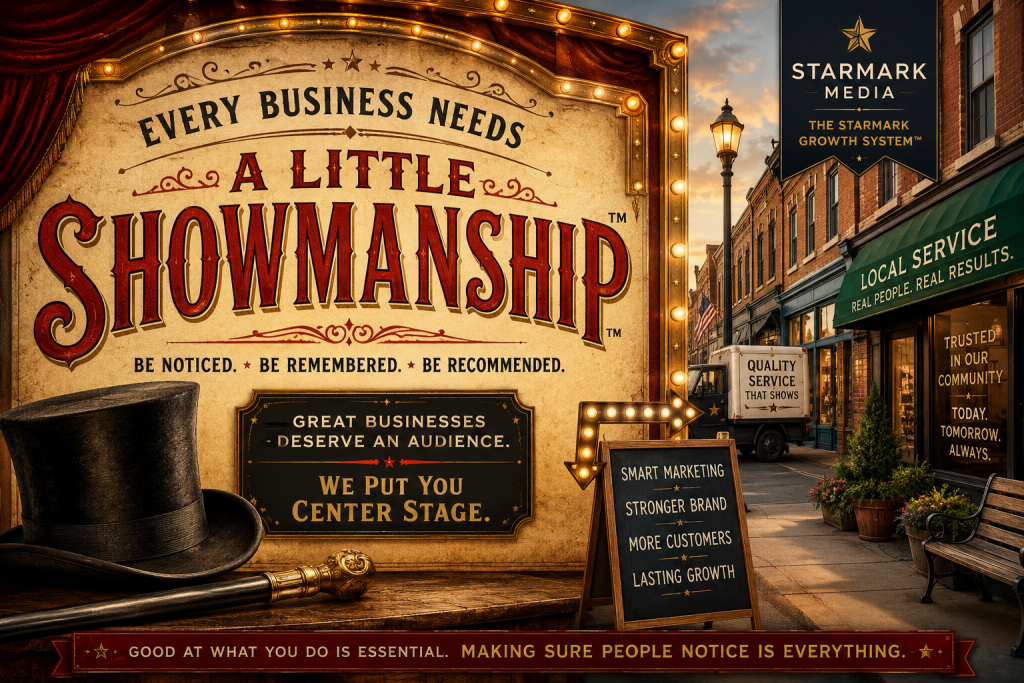
There is a big difference between being good at what you do and being remembered for it.
A plumber can do excellent work. An electrician can be dependable. A landscaper can transform a yard. A pressure washer can make an old driveway look almost new again.
But if nobody notices, remembers, or talks about that business, then quality alone may not be enough to drive growth.
That is where showmanship comes in.
At Starmark Media, when we say “Every Business Needs a Little Showmanship™;,” we are not suggesting that every business owner needs to become a circus promoter, wear a top hat, or turn every sales call into a spectacle.
We mean something much more practical.
Showmanship is the art of making a good business easier to notice, easier to understand, easier to remember, and easier to recommend.
And that principle has been working for a very long time.
Great Showmen Understood the Power of Attention
Long before Facebook, Google, television, radio, or even modern advertising agencies, great promoters understood one basic truth:
Before you can persuade someone, you first have to get their attention.
P.T. Barnum understood this exceptionally well. In P.T. Barnum’s Greatest Marketing Lesson: You Have to Get Their Attention First, we look more closely at how attention becomes the first step in every successful marketing message.
Barnum was not simply selling tickets. He was creating curiosity. He used bold headlines, unusual stories, memorable attractions, public events, and constant promotion to make people wonder what they were missing.
Harry Houdini understood it too.
He did not quietly arrive in a town, perform an escape, collect his money, and leave.
He created anticipation. Our Houdini lesson on using suspense in marketing shows why the performance often begins long before the customer sees the final result.
He might arrange a public challenge, attract newspaper coverage, or stage an escape where crowds could gather and watch. The performance often started long before Houdini ever slipped into the handcuffs.
Colonel Tom Parker understood the same principle while managing Elvis Presley. The Parker Files explores how positioning and packaging helped turn talent into a recognizable phenomenon.
Elvis had the talent, but Parker understood how to package, promote, position, and merchandise that talent until Elvis was no longer simply a singer.
He became an event.
And Walt Disney understood perhaps one of the most important lessons of all: the experience surrounding the product can become just as important as the product itself. That principle is at the heart of Walt Disney Didn’t Build Rides—He Built Experiences.
Different personalities. Different eras. Different businesses.
But they all understood something that still matters today:
People notice what is interesting. They remember what feels distinctive. And they talk about experiences that give them a story to tell.
That is showmanship.
Showmanship Is Not the Same as Hype
There is an important distinction here.
Showmanship does not mean exaggerating what your business can do. It does not mean making outrageous promises. It does not mean pretending to be something you are not.
Good showmanship actually works best when it draws attention to something real.
If you provide exceptional service, show it. If your customers love you, share their stories. If your work creates dramatic transformations, demonstrate them. If your employees care deeply about doing the job correctly, introduce them.
The purpose of marketing should not be to manufacture greatness that isn’t there. It should be to make the greatness that already exists harder to overlook.
Most Local Businesses Have More to Talk About Than They Realize
One of the most common marketing problems local businesses face is surprisingly simple: they don’t think they have anything interesting to say.
Behind simple service descriptions are hundreds of stories. The roofer can explain why one home developed a leak while the house next door didn’t. The electrician can show an outdated panel. The landscaper can document a transformation. The pressure washing company can show years of grime disappearing in minutes.
Education becomes content. Customer questions become content. Before-and-after photos become content. Humor becomes content. Employee stories become content. Customer reviews become content. Community involvement becomes content. The work itself becomes content.
A little showmanship simply helps bring those stories to center stage.
Your Social Media Page Is a Stage, Not a Bulletin Board
Many small businesses treat social media like the bulletin board at the grocery store. There is nothing wrong with promotional posts, but the problem comes when promotion is the only thing happening.
A better business social media strategy mixes education, entertainment, questions, stories, transformations, employees, customer experiences, community involvement, and promotion.
The business is still selling. It is simply becoming more interesting while doing it.
For a deeper look at this idea, read Social Media Isn’t a Bulletin Board—It’s a Stage.
Your Website Is Your Digital Marquee
Years ago, a theater marquee told people what was playing inside. Today, your website performs a very similar job.
Before calling you, many prospective customers will look you up. Does the website immediately tell them what you do? Does it look current? Does it work well on a phone? Are there real photos and customer reviews? Does the business look active?
Showmanship does not mean creating an elaborate website filled with unnecessary animation. It means presenting the business in a way that matches the quality of the service behind it.
We expand on that principle in Your Website Is Your Digital Marquee.
Your Reviews Are Part of the Show
Some of the strongest marketing a business will ever receive has already been written by its customers.
A five-star review is more than feedback. It is a miniature sales presentation from someone who has already experienced the company.
Good showmanship takes that social proof and gives it more visibility. Turn it into a graphic. Feature it on the website. Create a short video. Highlight it on Facebook. Include it in an email.
The customer already gave you the applause. There is no reason to leave the applause sitting quietly on one review page where almost nobody sees it.
See Your Five-Star Reviews Are Marketing Gold—Stop Leaving Them as Text for practical ways to turn reviews into ongoing marketing assets.
Customer Experience May Be Your Best Marketing
This is where Walt Disney’s influence becomes especially useful.
Many businesses think marketing ends when someone becomes a customer. In reality, some of the most important marketing begins afterward.
Was the appointment easy to schedule? Did someone answer the phone professionally? Did the technician arrive when expected? Was the employee courteous? Was the property treated respectfully? Did anyone follow up?
Every one of those moments influences what the customer eventually says about the business. Customer experience is not separate from marketing. Customer experience creates marketing.
A delighted customer becomes part of your advertising department without ever realizing it.
Familiarity Matters More Than Many Businesses Realize
People often choose businesses they recognize. Consistent marketing keeps your name present between buying decisions, so when the moment arrives, the customer doesn’t have to discover you. They simply have to remember you.
This is also why visibility can beat superior-but-invisible competition. Read Your Competitor Isn’t Always Better—They May Just Be More Visible.
You Don’t Need a Circus. You Need Something Memorable.
Small-business owners sometimes resist marketing because they don’t want to look gimmicky. The good news is that showmanship does not require gimmicks.
Sometimes showmanship is simply presenting something ordinary in a more memorable way.
Instead of posting “We clean driveways,” show a stained driveway becoming bright again. Instead of “We have great reviews,” let people hear one. Instead of “We are locally owned,” introduce the owner. Instead of “Call today,” give people a reason to care first.
None of this changes what the business does. It changes how clearly people see it.
What Would a Showman Notice About Your Business?
Imagine P.T. Barnum walked through your business tomorrow. What would he find interesting enough to put on a poster?
Imagine Houdini watched your team work. What transformation would make people stop and watch?
Imagine Colonel Parker looked at your company. What would he turn into a recognizable brand?
Now imagine Walt Disney experiencing your company as a customer. Where could you add one memorable touch?
Those questions are useful because sometimes the best marketing ideas are already inside the business. They simply haven’t been presented yet.
Good Marketing Makes Good Businesses Easier to Remember
At Starmark Media, we believe local businesses deserve more than occasional advertisements thrown onto Facebook whenever things get slow.
A strong marketing presence should continually remind the community who you are, what you do, why you are different, and why customers trust you.
It should educate. It should entertain. It should build familiarity. It should highlight customer experiences. It should demonstrate expertise. And occasionally, it should simply make someone smile.
That is what we mean when we say: Every Business Needs a Little Showmanship™;.
Not hype. Not tricks. Not empty spectacle. Just the understanding that being good at what you do and making sure people notice are two different jobs.
Your business handles the first one. Your marketing needs to handle the second.
And when the two work together, a company stops being just another name in a search result. It becomes a business people recognize, remember, and recommend.
Is Your Business Getting the Attention It Deserves?
You may already be doing outstanding work. The question is whether enough people in your community know it.
The Starmark Growth System™; is designed to help local businesses stay visible with consistent social media content, stronger presentation, customer review marketing, and a brand presence people remember.
Because great businesses deserve an audience.
And every business needs a little showmanship.™;
Leave a Reply
You must be logged in to post a comment.